
Canada’s New National Electricity Strategy
Last week, Prime Minister Carney announced Canada’s new National Electricity Strategy sends the right signal: electricity is now central to Canada’s affordability, competitiveness, energy security, and economic sovereignty.
The strategy recognizes the scale of the moment. Canada already has one of the cleanest electricity systems in the world, with approximately 80% non-emitting generation, and demand is expected to double by 2050. It also frames the opportunity clearly: if done well, electrification can lower total energy costs for many households, support industrial growth, and position Canada as a clean-energy superpower.
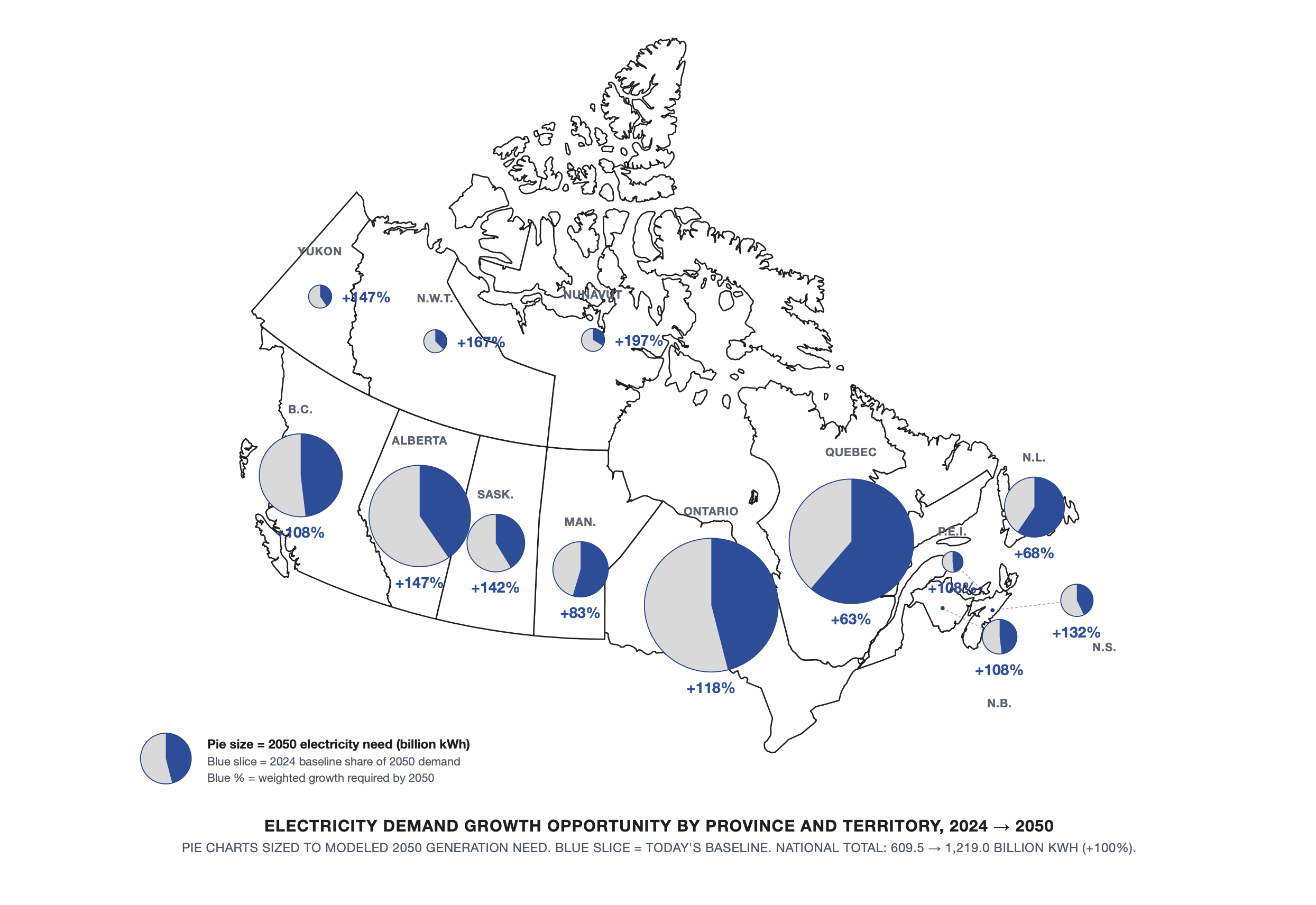
SGIN strongly supports the strategy’s focus on building more generation, strengthening transmission, growing the skilled workforce, and making more of the technologies and components that power the grid here in Canada.
The next test is execution.
Canada cannot deliver this strategy through large infrastructure alone. The immediate weaknesses are also local, digital, and practical: constrained distribution grids, limited visibility into energy data, slow customer-side adoption, fragmented planning, and uneven readiness across provinces and utilities.
That is why SGIN believes the National Electricity Strategy will need to put equal focus on four delivery priorities:
First, affordability must remain the organizing principle. The least-cost grid is not only the grid we build; it is also the capacity we unlock through efficiency, demand response, distributed energy resources, storage, smarter buildings, and better use of existing assets.
Second, Canada needs better access to trusted energy data. Grid planning, investment decisions, customer programs, intertie development, affordability measures, and AI-enabled energy solutions will only be as strong as the data behind them. A modern electricity strategy requires secure, governed, privacy-protecting data access so utilities, governments, innovators, and communities can make better decisions faster. Transparency begins to unlock the ability for consumers to participate in their own energy future.
Third, digitalization must be treated as core infrastructure. Smart meters, sensors, advanced grid controls, AI-enabled analytics, cybersecurity, customer energy management, and integrated planning tools are not optional add-ons. They are how Canada can defer avoidable costs, improve reliability, support electrification, and give customers more choice.
Fourth, local and distributed energy solutions must be part of the national build. Heat pumps, EV charging, community and consumer solar, batteries, demand flexibility, community energy systems, and industrial energy management can provide the grid flexibility needed, improve resilience, and help communities participate directly in the clean-energy economy.
Prime Minister Carney’s statement that “when we master energy, we master our destiny” captures the national ambition. For SGIN, the practical extension is clear: Canada masters energy when communities, utilities, businesses, and governments have the tools, data, workforce, and market pathways to act locally and scale nationally.
The opportunity now is to move from strategy to implementation.
SGIN is ready to work with members, governments, utilities, Indigenous partners, technology firms, and training organizations to help translate the National Electricity Strategy into practical roadmaps, readiness benchmarks, data-access models, DER deployment pathways, and supply-chain opportunities that deliver benefits for customers and communities.
For organizations looking to respond to the federal consultation or position projects for the next phase of electricity investment, the question is no longer whether Canada will electrify. The question is how quickly, affordably, and intelligently we can deliver it.
For SGIN, 2026 will bring opportunity discovery opportunities and Canada’s capability catalogue. SGIN can help turn that question into practical opportunities.
Want to learn more? Become a member