The right energy, at the right time for the right purpose
Changing the narrative to position Canada as a Global (ALL) Energy Superpower
Introduction
Energy is the foundation of modern prosperity, powering homes, businesses, military industries, and entire economies. Canada is one of the few nations to possess significant strengths across every major energy domain, from hydrocarbons to hydropower to small modular reactors (SMRs) and emerging clean fuels. This breadth provides Canada with a unique opportunity, to not only supply its own needs but to lead the global transition toward a sustainable and low carbon energy future. It also emphasizes clean energy and renewable development, further enhancing Canada’s reputation and influence in international climate and energy forums. While challenges persist, Canada’s diversified and resource-rich energy mix serves as a strong foundation for maintaining and expanding its role as a major player in the global energy market.
This white paper organizes Canada’s energy system into three macro categories: Fossil Fuels, Electricity-Based Energy, and Biobased Energy. These categories highlight the different strengths and challenges of Canada’s energy mix, and demonstrate how, together, they create the foundation for Canada’s role as an energy superpower.
Let’s change the narrative to support “the right energy, at the right time for the right purpose at the right price”.
The criteria for “right” changes over time. At the turn of the last century, as energy systems began to evolve, we are primarily worried about access. Low reliability was acceptable. Today, however, our society fully relies mostly on centrally provided energy systems to operate at high reliability and low cost. Consumers are seeking more choices not only for energy types but also to have more independence from 3rd party entities. Environmental footprint is again critical to the definition of “right” thus making finding the balance between cost, societal benefits and benefits to the consumers an evolving challenge.
Fossil Fuels
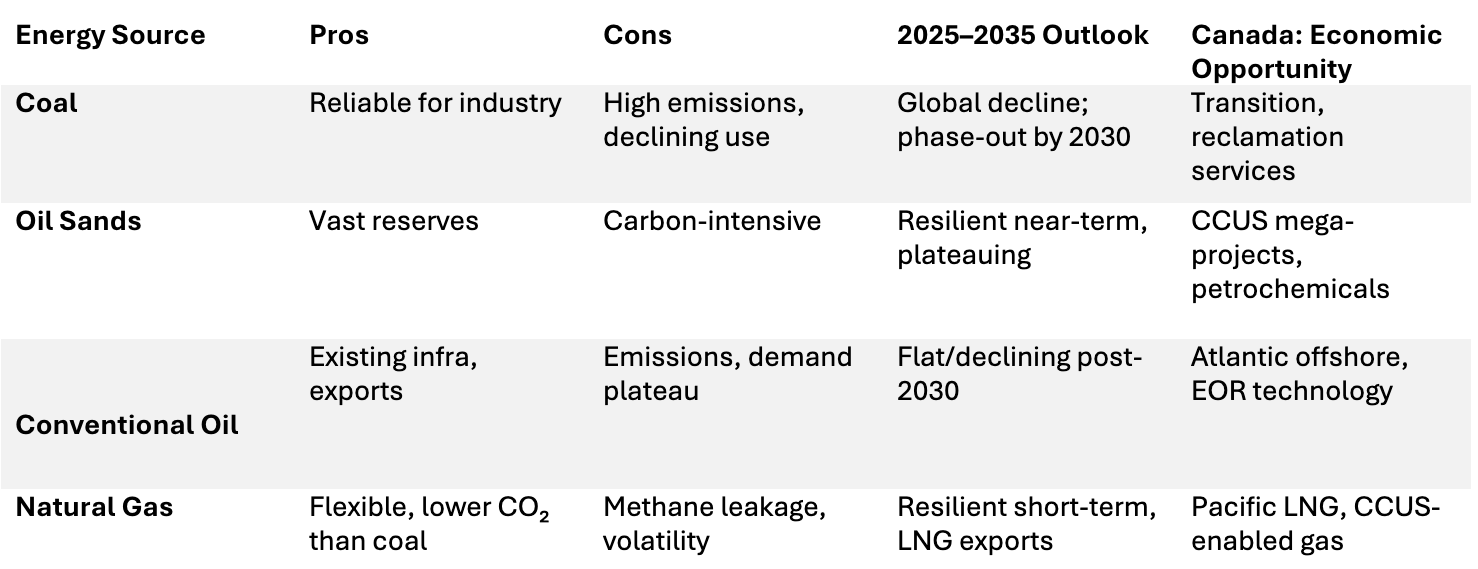
Fossil fuels remain central to Canada’s economy, providing export revenues, jobs, and energy security. Coal, oil, and natural gas are deeply embedded in the nation’s industrial base. But their future depends on innovation and emissions reductions, particularly through carbon capture, utilization, and storage (CCUS), and methane abatement. In the decade ahead, fossil fuels will remain significant, even as Canada works to balance this legacy with net-zero ambitions and evolving lower-cost energy solutions.
Electricity-Based Energy
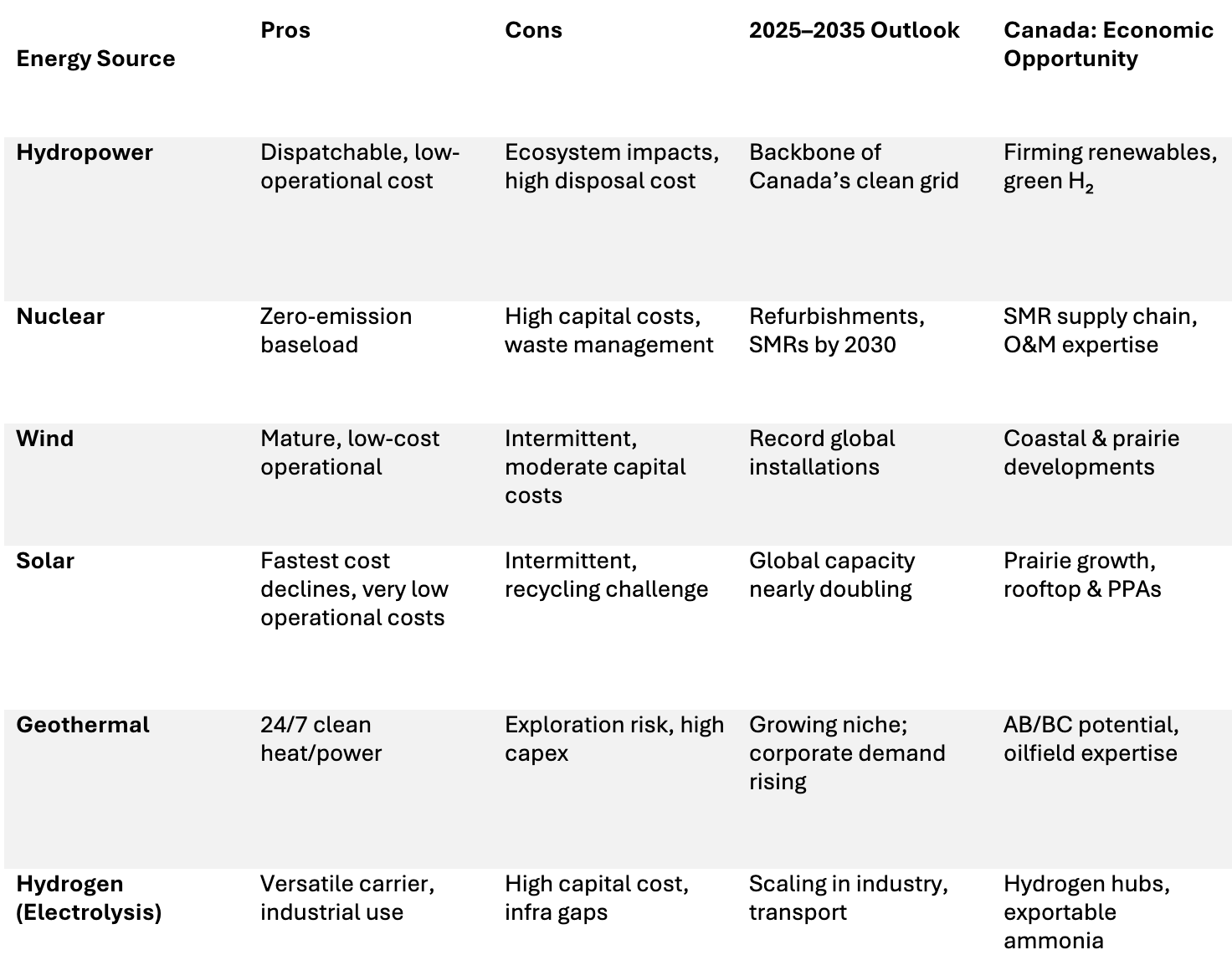
Electricity is the backbone of Canada’s clean energy advantage. With one of the world’s cleanest grids, Canada generates over 80 percent of its power from non-emitting sources. Hydropower is dominant, while nuclear, wind, and solar are growing rapidly. Emerging technologies such as geothermal and electrolytic hydrogen will further diversify the grid. Continued electrification accelerating across transport, heating, and industry, Canada’s competitiveness will rely heavily on these essential resources.
The core will be to electrify everything and simultaneously develop green electricity. Achieving net zero will require moving away from fossil fuels to renewables, decarbonising transport and reducing emissions from industrial processes. It will also require novel approaches to manage the hard-to-abate sectors where electrification or decarbonisation of processes may not be feasible even in the medium term, such as long-distance air travel or agriculture.
Carney, Mark. Values (p. 301). McClelland & Stewart. Kindle Edition.
Although the above electrify everything direction is not completely practical for various reasons, it does put the right emphasis on the importance of the use of electricity and the need to clean up how we generate electricity. Electricity infrastructure provides a way to harvest “free fuel” in solar and wind applications to generate usable energy, and the grid provides us a safe mechanism to move energy long distances at the speed of light and electricity provides us a safe energy source that we can utilize in our homes and for transportation. Additionally, electricity provides a medium for biobased fuels and fossil fuels to be usable in many applications.
Role, from transport and buildings
Biobased Energy
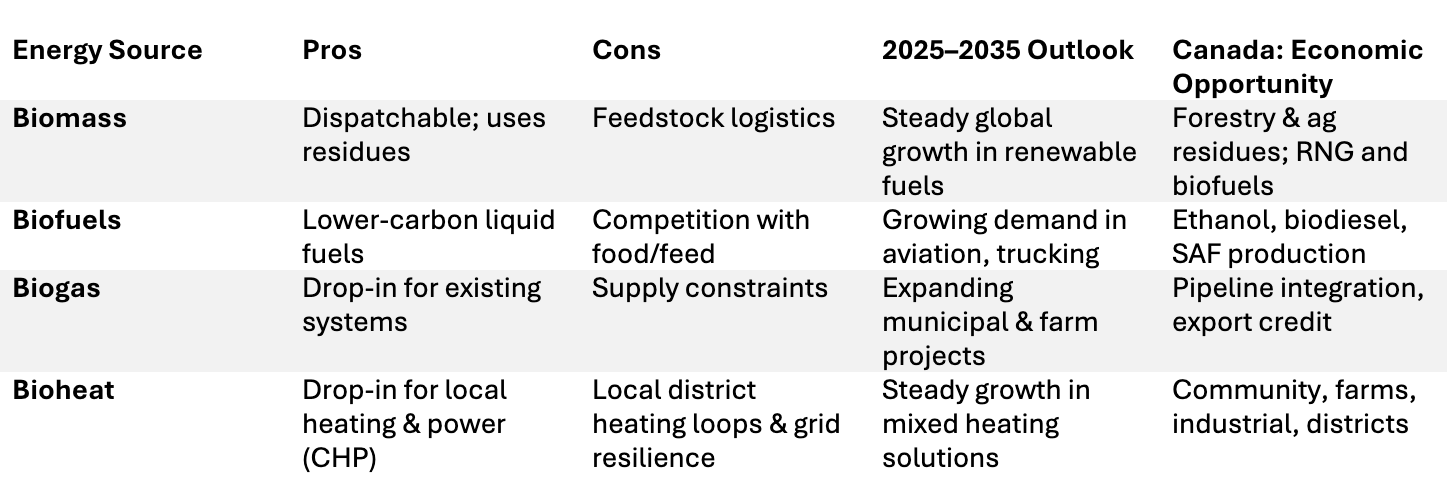
Biobased energy demonstrates Canada’s ability to turn natural resources into sustainable energy solutions. Forests, farms, and organic waste streams provide raw material for bioheat, renewable natural gas, and advanced biofuels. These energy sources are critical for sectors like aviation, shipping, and heavy industry, where electrification is less practical. Canada’s abundance of feedstock and technical expertise position it to become a global leader in multiple forms of biobased energy including:
Biomass Power Generation using organic materials such as wood pellets, forestry residues, and agricultural residues to produce electricity and heat through combustion or gasification.
Biofuels to produce renewable transportation fuels like ethanol from agricultural waste and biodiesel (from vegetable oils or animal fats).
Biogas generation through anaerobic digestion of organic waste, which can be used for electricity, heating, vehicle fuels or upgraded to produce renewable natural gas (RNG).
Bioheat, using bio-based fuels in heating systems, such as wood pellets or bio-oils.
Benefits of Biobased Energy:
Renewable Resources: Canada can benefit from locally sourced, renewable biological materials, readily available across the country, reducing dependence on finite fossil fuels.
Carbon Neutrality: When managed sustainably, biobased energy can be nearly carbon-neutral, as the carbon released during combustion is offset by the carbon absorbed during the growth of biomass. This is becoming increasingly important in manufacturing industries having to quantify and validate the carbon intensity of their manufactured goods.
Economic Development: Utilizing renewable natural resources helps support rural economies and creates jobs and resiliency in resource-based sectors like agriculture, forestry, and bioenergy industries.
Waste Reduction: Diverting organic waste from landfills helps to reduce methane emissions and environmental pollution, supporting Canada’s net-zero goals.
Energy Security: Leveraging Canada’s natural resource base helps to diversify its energy sources, enhancing resilience against supply disruptions.
Environmental Benefits: The utilization of biobased energy supports the reduction of greenhouse gas emissions compared to conventional fossil fuels, contributing to climate change mitigation.
Canada's ability to convert natural resources into these multiple forms of biobased energy highlights its sustainable approach to energy production and its capacity to contribute to a greener, more resilient energy future.
Canada’s policy and technology choices should recognize that biobased energy provides the most energy value when displacing heating fuels directly. At the same time, electricity generation from biomass plays a role in balancing the grid, with storage capacity, particularly where waste/residue streams are available 24/7 (forestry residues, agricultural residues, and municipal solid waste).
Efficiency
There has been significant work across Canada to improve efficiencies of various kinds particularly at the residential level as exemplified below. Although not a strategy that directly provides more energy, it is a primary strategy for providing more energy by using less where practical.
Two key concepts here are important.
Energy efficiency: this strategy is applied typically when an energy load can by modified or changed to reduce the amount of energy needed to provide the same or similar output.
Energy Effectiveness: this strategy can be applied when the choice of energy is reevaluated based on the objectives the stakeholder is trying to accomplish. One example would be to switch from an internal combustion’s engine to an electric or hybrid vehicle. These approaches rethink the energy choice and provide a reduction in the need for total energy due to vehicle efficiencies.
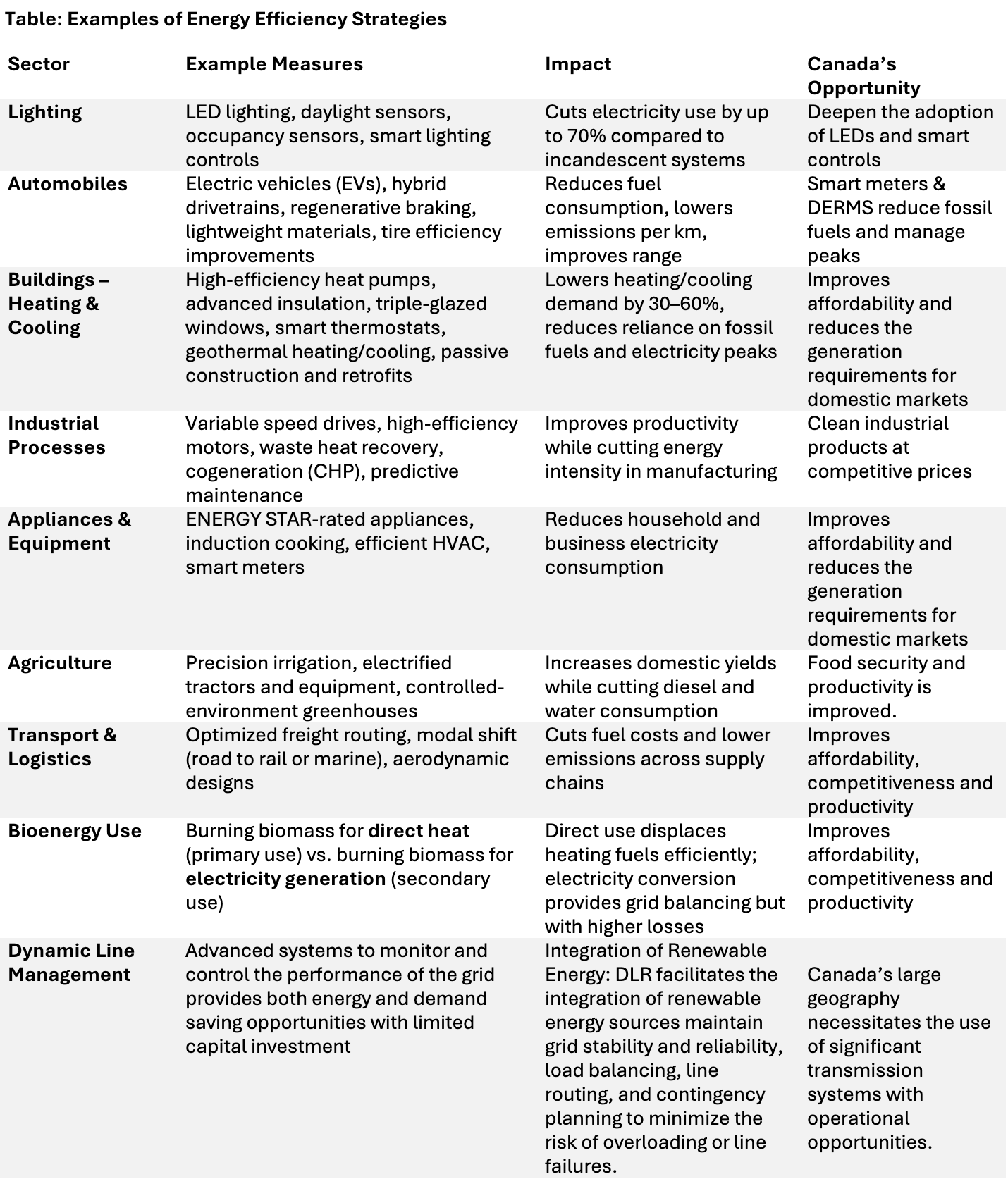
However, these measures have an incremental effect if the energy source and transportation of energy efficiencies are not addressed as well, to enable the right energy being used at the right time.
Fuel Switching is a specific strategy based on efficiency, economic and carbon reduction objectives.
Fuel switching strategies also intersect with biofuels. For example:
Home Heating: Switching from oil furnaces to pellet or wood biomass boilers is often more efficient and can be carbon-neutral if feedstock is sustainably sourced. Switching from fossil-based fuels to cold temperature heat pumps is a significantly more efficient approach (use much less energy), has a smaller carbon footprint and can also reduce costs. Some jurisdictions in Canada are not well suited to heat pumps due to extreme climates, but the technology advancements are making these viable for most of the population in Canada.
Electricity Generation: While biomass-fired power plants exist, their role should be complementary—supporting grid reliability rather than serving as the main pathway for biofuel use.
Transport: Blending biofuels (ethanol, biodiesel, sustainable aviation fuel) displaces petroleum fuels in existing engines.
Industry: Using biogas or renewable natural gas instead of fossil natural gas for process heat.
The principle of fuel switching is clear: biofuels deliver their highest efficiency when applied directly to heat or fuel substitution. Electricity generation should be considered a strategic pathway, used primarily when waste streams or balancing needs justify the conversion.
Recap
Canada's energy landscape is uniquely diversified, spanning fossil fuels, electricity-based energy, and biobased energy, positioning the nation to be a global leader in the transition to sustainable energy. This white paper outlines Canada's strengths, challenges, and economic opportunities across these energy sectors.
Fossil fuels remain vital during transition: Coal, oil sands, conventional oil, and natural gas continue to underpin Canada's economy, providing jobs and export revenues, while facing challenges like emissions and global demand shifts. Innovations like carbon capture and methane reduction are key to their future.
Electricity-based energy leads clean power: Over 80% of Canada's electricity comes from non-emitting sources, primarily hydropower, with growing contributions from nuclear, wind, solar, geothermal, and electrolytic hydrogen, supporting electrification in transport and industry.
Hydropower is foundational: It provides low-cost, dispatchable power but carries ecosystem impacts; it remains the backbone of Canada's clean grid and supports renewable firming and green hydrogen production. Nuclear and SMRs expand clean baseload: Nuclear energy offers zero-emission baseload power with challenges like high costs and waste; refurbishments and small modular reactors (SMRs) are planned by 2030, fostering supply chain and operational expertise.
Wind and solar grow rapidly: Both are mature, low-cost, and expanding technologies with intermittency challenges; wind sees development in coastal and prairie areas, while solar experiences fast cost declines and growth in the prairies and rooftop installations.
Biobased energy offers versatile solutions: Utilizing biomass, biofuels, biogas, and bioheat from natural resources, bioenergy supports sectors hard to electrify, such as aviation and heavy industry, with emphasis on direct heat use for efficiency and electricity generation for grid balancing.
Energy efficiency and fuel switching: Strategies include LED lighting, electric vehicles, high-efficiency heating, and industrial process improvements, alongside switching to biofuels and renewable natural gas, which reduce emissions and enhance energy use across sectors. Fundamental improvements to transmission support these examples, moving the power to where its needed as efficiently and effectively as possible.
Canada’s all energy future will be shaped by the interplay of fossil fuels, electricity-based energy, and bioenergy. Fossil fuels will remain pillars of economic strength in the near term, while electricity-based energy defines the country’s clean advantage. Bioenergy adds a versatile and sustainable pathway for hard-to-decarbonize sectors.
By weaving together these three categories, Canada can position itself not only as an energy exporter, but as a strategic leader in the global clean energy transition. Economic opportunities abound: Canada’s energy sectors offer prospects in CCUS projects, petrochemicals, LNG exports, SMR supply chains, renewable fuel production, and bioenergy innovations, leveraging the country's resource wealth and expertise to lead global energy transition efforts. None of these strategies scale at pace without intentional policy and market reform enabled by a streamlined regulatory support.
Made in Partnership